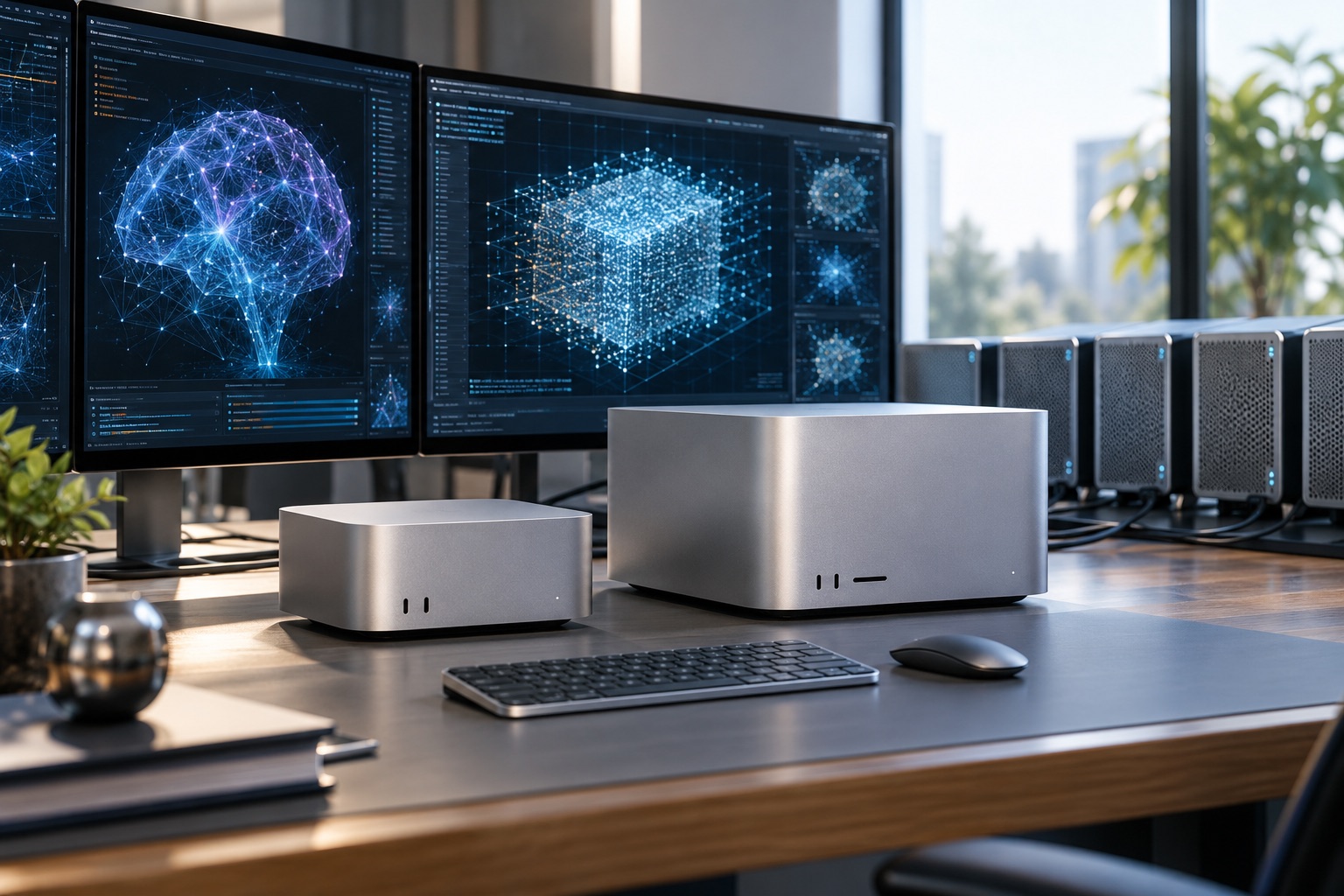
Apple has started shipping its new Mac mini and Mac Studio, and the company is increasingly presenting the desktops not only as creative workstations but as local infrastructure for large AI models.
The M5 Ultra Mac Studio supports up to 512GB of unified memory with as much as 1.2TB/s of memory bandwidth. Apple has also added a path for linking multiple Mac Studio systems over Thunderbolt 5 using RDMA for distributed inference.
What happened
The new Mac Studio is available with M5 Max or M5 Ultra. The top configuration scales to a 36-core CPU, an 80-core GPU and 512GB of unified memory. Apple says that memory capacity allows very large language models to run entirely on device.
The Mac mini has also moved to M6 and M5 Pro. Apple is tying the latest GPUs, which include Neural Accelerators in every core, to local AI, automation and agentic workloads in macOS 27.
Clustering is a notable part of the strategy. Thunderbolt 5 RDMA can link multiple Mac Studio systems, and Apple reports up to three times faster distributed AI inference than a single system in its own tests.
Reuters reports that Apple demonstrated four Mac Studios running a trillion-parameter model to identify and fix a graphics-related coding bug. Apple is pitching this kind of setup as an alternative to metered cloud AI for workloads where organizations can justify owning the hardware.
Pricing starts at $899 for the M6 Mac mini and $2,499 for the M5 Max Mac Studio. The M5 Ultra version starts at $5,499, with high-end configurations costing much more. The 512GB memory option is scheduled for late October.
Why it matters
Large unified-memory pools give Apple a distinctive angle for local inference. The CPU and GPU share the same memory, avoiding the strict separation between system RAM and discrete GPU VRAM found in many conventional workstations.
Local AI can be attractive to organizations that want predictable costs, tighter data control or less dependence on per-token API billing. Once the hardware is owned, each additional inference does not generate a separate cloud token charge, although power, maintenance and hardware costs still matter.
Apple remains a relatively small player in enterprise desktops compared with Windows, so the strategy is far from guaranteed to reshape corporate computing. But 512GB of unified memory and built-in clustering move the Mac closer to a specialized AI workstation category rather than a conventional desktop alone.