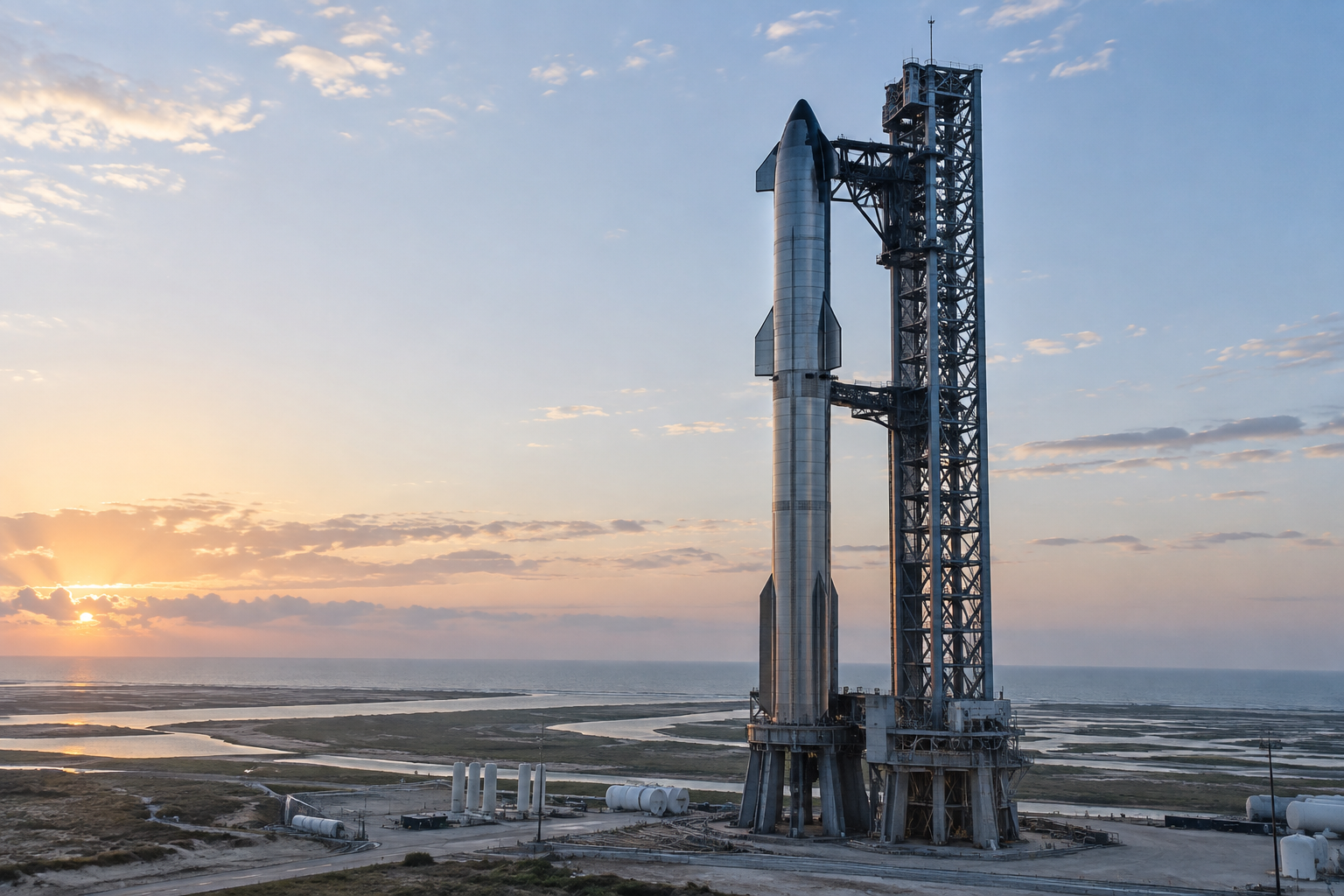
SpaceX is preparing for what could be the biggest change in the Starship test program since integrated flights began in 2023. Flight 14 is now targeted for no earlier than September 28, 2026, and unlike every previous mission, the spacecraft is expected to enter a true Earth orbit and deploy an operational payload.
The 75-minute launch window is scheduled to open at 7:15 a.m. Central time, or 12:15 UTC, from Pad 2 at Starbase, Texas. SpaceX says the attempt remains pending regulatory approval, so the date is still subject to change.
Starship’s first real trip into orbit
Previous integrated Starship tests deliberately followed suborbital trajectories. The vehicle accelerated to near-orbital velocity and traveled through space, but its trajectory was designed to bring it back into the atmosphere without completing a sustained orbit around Earth.
Flight 14 changes that mission profile. SpaceX’s published plan and independent launch listings indicate that Starship is expected to reach an altitude of roughly 275 kilometers, stay in space for close to 10 hours and complete about six orbits before performing a deorbit maneuver. The spacecraft is then expected to reenter and splash down in the Pacific Ocean west of Chile.
Why it matters: Flight 14 is intended to test Starship as an orbital transportation system rather than simply a spacecraft that briefly reaches space. It combines orbital insertion, extended on-orbit operations, payload deployment and a controlled departure from orbit in a single mission.
Twenty-six Starlink V3 satellites are riding aboard
The most consequential payload is a batch of 26 third-generation Starlink satellites. Spaceflight Now lists Flight 14 as the first planned orbital deployment of Starlink V3 from Starship. The previous Starship mission carried next-generation Starlink spacecraft to test deployment, but because that flight remained suborbital, those satellites did not become part of the operational constellation.
This time, the satellites are intended to remain in orbit and eventually serve Starlink customers. According to specifications cited by Engadget, SpaceX rates each V3 satellite for up to 1 Tbps of downlink capacity and 160 Gbps of uplink capacity — roughly 10 and 22 times the corresponding figures for the earlier generation in SpaceX’s comparison.
That makes Flight 14 more than another engineering demonstration. If the satellites are inserted into their intended orbit, Starship will have completed one of its core commercial jobs for the first time: carrying useful hardware into orbit and releasing it where it can become operational.
Ship 41 and Booster 21
The mission is scheduled to use Ship 41 as the upper stage and Booster 21 as the Super Heavy first stage. Spaceflight Now identifies Pad 2 at Starbase as the launch site. Booster 21 completed a full 33-engine static-fire test in late August, while Ship 41 had previously completed testing of its six Raptor engines.
SpaceX does not plan to attempt a tower catch on this flight. Super Heavy is expected to perform a controlled splashdown after stage separation, while the Starship upper stage will remain in orbit for hours before returning over the Pacific. The choice keeps the mission focused on two major milestones: reaching orbit reliably and delivering payload.
Six orbits make this a different kind of test
A roughly 10-hour mission places very different demands on Starship than the short suborbital flights that came before it. Power, communications, navigation, thermal control and propulsion systems must remain healthy for hours rather than minutes.
The deorbit sequence is particularly important. Reaching orbit is only part of the mission: Starship also needs to retain the ability to carry out a controlled braking burn after multiple laps around Earth. A successful ascent followed by a spacecraft that cannot safely leave orbit would not demonstrate the complete capability SpaceX is trying to validate.
That matters far beyond Starlink. SpaceX describes Starship as a fully and rapidly reusable transportation system intended for satellite delivery, lunar missions and eventually much longer journeys. The broader architecture also relies on orbital propellant transfer, which requires spacecraft to operate predictably in orbit for extended periods.
Starship and Starlink are starting to converge
Starlink V3 gives SpaceX a particularly useful payload for bringing Starship into operational service. The new satellites are designed for far greater network capacity, while Starship’s enormous payload volume is intended to move larger spacecraft and larger batches than Falcon 9 can accommodate.
Until now, Starship has primarily been a development program consuming hardware in pursuit of flight data. An orbital Starlink deployment would mark an important shift: the rocket program would begin directly expanding another major SpaceX business at the same time it continues testing the vehicle.
Starlink also gives SpaceX a built-in stream of payloads. The company does not need to wait for a commercial customer willing to take the risk of an early Starship mission. It can gradually increase the vehicle’s workload using its own satellites while gathering operational data on every flight.
What success would look like
Flight 14 has several layers of objectives. First, Booster 21 and Ship 41 must complete ascent and place the upper stage into its planned orbit. Second, Starship must successfully deploy all 26 Starlink V3 satellites. Third, the spacecraft needs to remain operational for roughly 10 hours and complete its deorbit sequence. Finally, SpaceX will collect data from an orbital-speed atmospheric reentry using the latest vehicle configuration.
Even a partial success would expose Starship to a much richer set of conditions than its earlier suborbital tests. But a successful satellite deployment would be the most visible transition point. It would mean Starship had moved beyond demonstrating that it can reach space and had, for the first time, performed a practical orbital transportation mission.
For now, September 28 remains a no-earlier-than target. Flight 14 has already moved from earlier September dates, and SpaceX says regulatory approval is still required before launch.