Researchers have published a direct-air-capture system in Nature Energy that uses a symmetric nickel-hydroxide electrochemical cell with a hydroxide exchange membrane to remove carbon dioxide from ambient air.
The work stands out because it goes beyond a short bench-scale demonstration. The team ran a laboratory cell for 5,000 hours and then scaled the concept into a nine-cell stack with 300-square-centimeter cells.
What happened
The design uses two similar nickel-hydroxide electrodes. By cycling their electrochemical state, the system can capture CO2 from incoming air and later release a more concentrated stream without relying on the high-temperature regeneration step used by many thermal-swing sorbents.
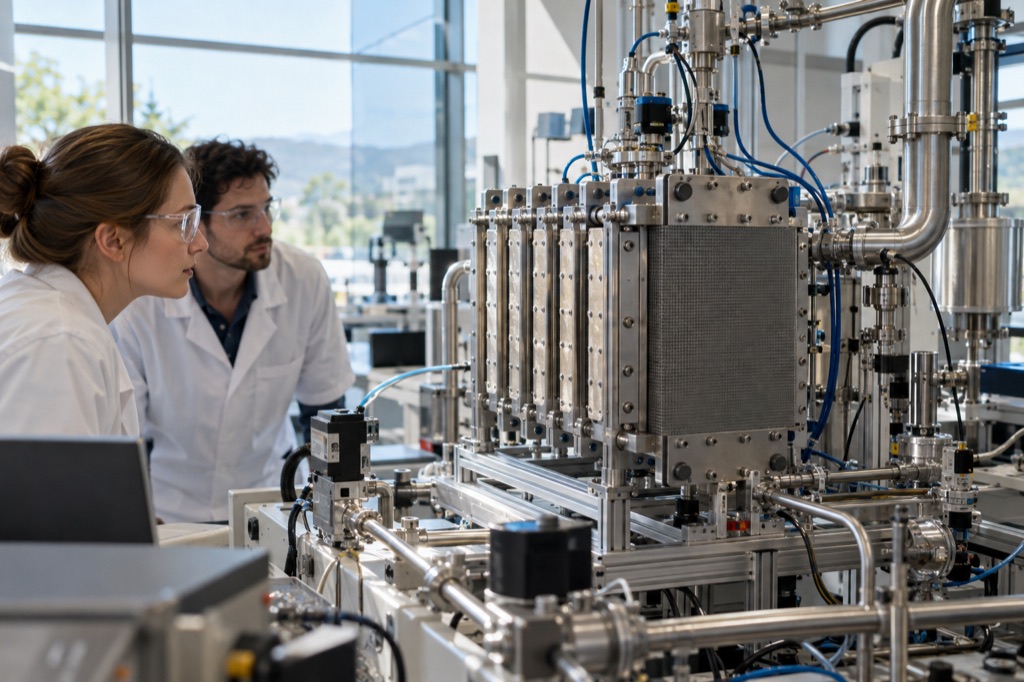
A 25-square-centimeter device was tested for 5,000 hours. The researchers then built a 9 × 300-square-centimeter stack and operated it for 48 hours. The paper reports an energy requirement of 132 kJ per mole of CO2, equivalent to roughly 0.83 MWh per tonne.
The pilot-scale stack reached a CO2 flux of about 0.19 moles per square meter per hour and met a 300-pascal pressure-drop target. Pressure drop matters because direct-air-capture equipment must move very large volumes of air through the system.
The authors outline a potential pathway below $100 per tonne of CO2 as the technology improves and scales. That is a projection rather than a demonstrated commercial price: the system remains an experimental platform and does not yet establish the economics of a full industrial DAC plant.
Why it matters
Direct air capture is difficult because atmospheric CO2 is extremely dilute. A practical system must process huge quantities of air, so heat, fans and sorbent regeneration can quickly dominate both energy use and cost.
An electrochemical process could shift more of that burden toward electricity and potentially pair well with low-carbon power. In this study, the combination of a long durability run, larger cell area and explicit pressure-drop measurements makes the engineering case more meaningful than a short proof-of-concept experiment alone.
Major commercialization questions remain, including long-term stack durability, membrane and electrode manufacturing, capital cost and maintenance. Even so, the study suggests electrochemical DAC is moving from small laboratory cells toward hardware that is easier to evaluate as a scalable process.