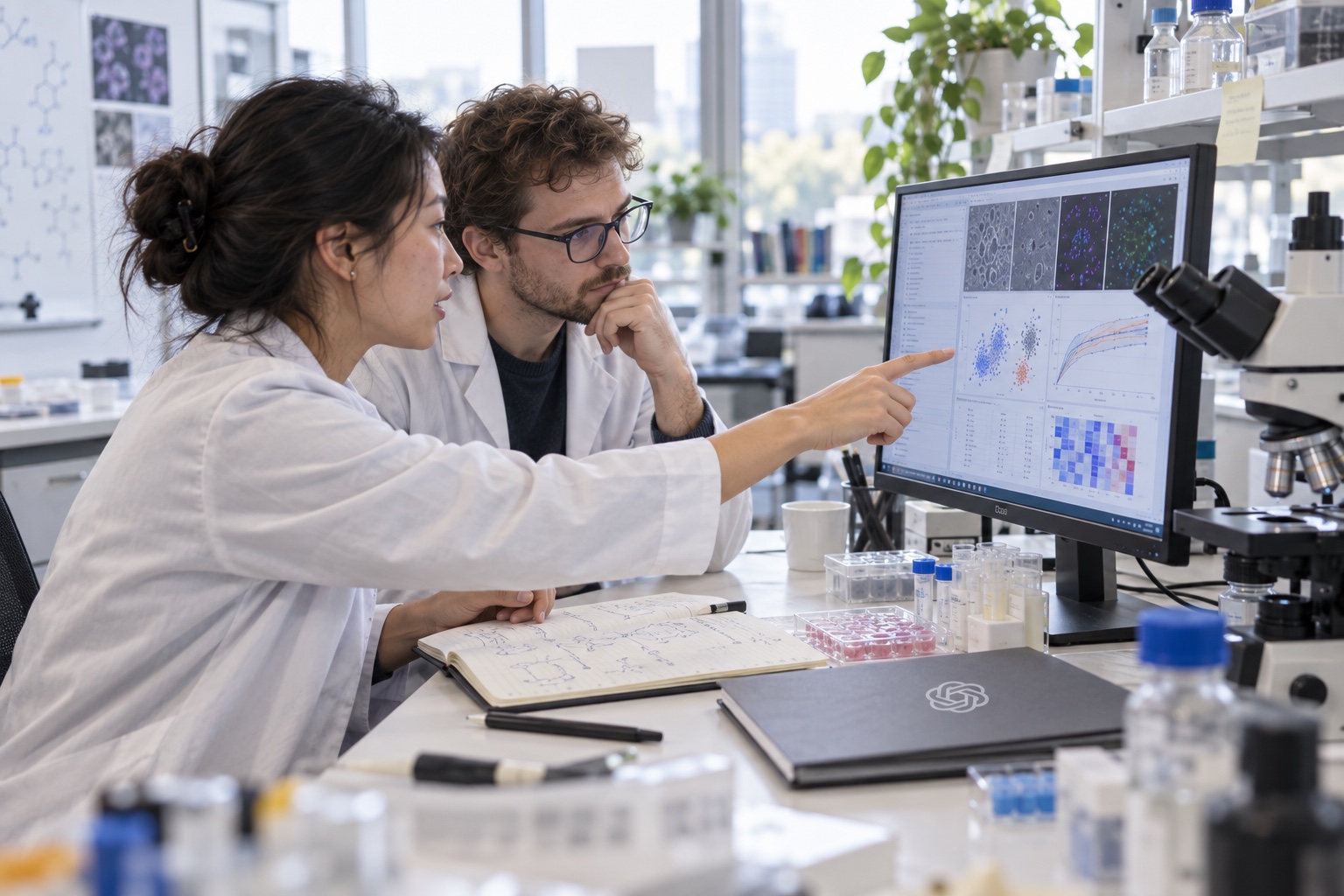
The next target is considerably more ambitious. By March 2028, OpenAI wants an automated AI researcher that can take on a larger part of the scientific cycle. The company links the goal to faster development of new models, while also acknowledging that stronger performance on individual tasks does not mean science as a whole will accelerate at the same pace.
What the intern can do
The work is mainly about programming and machine-learning experiments. An agent can work with code, prepare evaluations, look for errors, run a series of experiments and analyze the results. The task must remain bounded and under a researcher’s supervision.
OpenAI says its staff are increasingly using several agent sessions in parallel. According to the company’s internal data, researchers have become faster at changing code and running more experiments. Adoption is growing especially quickly inside research teams.
That still does not make the system an autonomous scientist. A human chooses the direction, frames the problem, evaluates the evidence and decides which result deserves further work. The agent speeds up individual stages rather than replacing the entire process.
Why faster steps do not equal faster discovery
Scientific work involves more than writing programs. Researchers need a testable hypothesis, an experiment design, compute resources, the ability to notice an unexpected result, a way to rule out error and enough background knowledge to interpret what they see.
When code and experiment runs become faster, other stages become bottlenecks: access to computing, data quality, interpretation and verification. OpenAI explicitly warns that the overall pace of research is unlikely to rise as quickly as the measurable performance of its agents.
There is also a methodological limit. The published figures come from inside OpenAI itself. They show a change in the company’s workflow, but do not prove that the same system will have the same effect in another laboratory or industry.
AI self-acceleration: reality or forecast?
The idea of an automated researcher matters because AI can help create the next generation of AI. If a system speeds up the search for architectures, experiment preparation and result analysis, each development cycle could become shorter.
There is still a large distance between a useful research agent and uncontrolled self-improvement. Today’s systems depend on human goals, computing infrastructure, data and release procedures. Even a successful experiment does not become a new model without extensive validation and training.
That is why the word intern is more accurate than AI scientist. It describes a useful system while keeping a human in charge of direction and responsibility.
What it changes beyond OpenAI
If the approach holds up, similar agents could speed up research into medicines, materials, software and engineering systems. Their first practical role will not be making discoveries alone, but shortening the queue of routine work: preparing code, checking alternatives, processing data and finding inconsistencies.
For research organizations, this creates a new question: how should they verify output from a system that can run more experiments than a person can carefully review? Speed without transparent verification can increase not only useful findings, but also the number of persuasively presented mistakes.
Conclusion
OpenAI has reached a notable but internally defined milestone. Its automated intern can already save days of work on some tasks, yet it remains a tool under human direction. The real test will not be how much code it can write, but whether it can produce reproducible results that withstand independent scientific review.